Let us speak of the ancient and the modern. Of how one encounters the other. Of how both concern the future.
There once lived on this planet a man who looked beyond apparent certainties towards a world in continual transformation. His name was Heraclitus, the Presocratic philosopher from Ephesus, active around 500 BCE. His thought continues to challenge us because it touches something we encounter every day and struggle to accept: change.
Heraclitus and the Untrodden Path
According to ancient tradition, Heraclitus relinquished a hereditary royal office in favour of his brother. This image suits the independent and often critical character we encounter in his fragments. The biographical stories preserved by Diogenes Laertius, however, were written centuries later and require care when treated as historical facts.[2]
His work survives in fragments, quoted by other authors. These brief sayings, dense and often enigmatic, continue to open vast paths for thought.
Rest Within Change
The familiar expression “everything flows” summarises a widespread reading of his philosophy. We should distinguish it, however, from a securely preserved, verbatim fragment. Plato’s presentation of Heraclitus played a decisive role in associating him with universal flux.[3]
In fragment B12, we encounter the image of the river: different waters flow upon those who step into the same rivers. One influential interpretation brings change and continuity into view together. The waters change, while we continue to recognise the river.[1][3]
Perhaps this is one of the most fruitful aspects of his thought. Some things endure through their transformations. Their stability has the character of a process.
“It rests by changing,” we read in the brief fragment B84a. The phrase invites us to reconsider what we mean when we ask the world, and ourselves, to remain the same.[1]
Logos and the Shared World
In the thought of Heraclitus, change is connected with Logos. The word has many meanings, and its interpretation remains debated. Here, we can approach it as the common account or order through which the world becomes intelligible.
In fragment B2, Logos is presented as common, while most people live as though each possessed a private understanding. In the image of waking and sleeping preserved as B89, those who are awake share a common world, while sleepers turn, each to a world of their own.[1]
The challenge remains familiar. How often do we truly listen to the world, and how often do we hear our own convictions returning to us? The search for Logos asks us to move beyond that self-sufficiency.
Ever-Living Fire and Measure
In fragment B30, the world is described as common to all, made by neither god nor human, and as an “ever-living fire,” kindling and going out in measures.[1]
Fire offers a striking image of becoming. We watch it exist through continual transformation. The emphasis on measure adds something essential: change is presented alongside proportions and constraints. Even the Sun, Heraclitus says in B94, would be held accountable if it overstepped its measures.[1]
This ancient cosmological image retains its philosophical force, although its concepts belong to a different historical and intellectual setting from those of present-day physics.
War and the Tension of Opposites
“War is the father of all,” we read in fragment B53. Heraclitus goes on to speak of gods and humans, slaves and free people. The saying connects cosmic conflict with actual human relations of power.[1]
The image of the bow and the lyre in B51 illuminates another aspect of this thought: opposing tensions can form a unity. Harmony contains tension.[1]
This philosophical description calls for careful interpretation. Connecting conflict with creation does not, by itself, establish a moral justification for every act of human violence. Its relationship with physics likewise requires specific arguments beyond similarities between words.
Heraclitus and Modern Physics
Today, we can bring this thought into conversation with physics. Transformations and relationships between things provide fruitful starting points. The difference in methods remains essential: a physical theory is formulated mathematically and assessed through observations and experiments.
Philosophical affinities help us formulate questions. Scientific confirmation requires its own evidence. Keeping this distinction gives the encounter between ancient thought and modern science greater depth.
The Aeons of Roger Penrose
Roger Penrose’s conformal cyclic cosmology offers a contemporary starting point. In this proposed model, the remote future of an expanding cosmic epoch is connected, through a conformal geometrical description, with the Big Bang of the next. Each epoch is called an aeon. This transition is a research proposal involving particular physical and mathematical assumptions.[4]
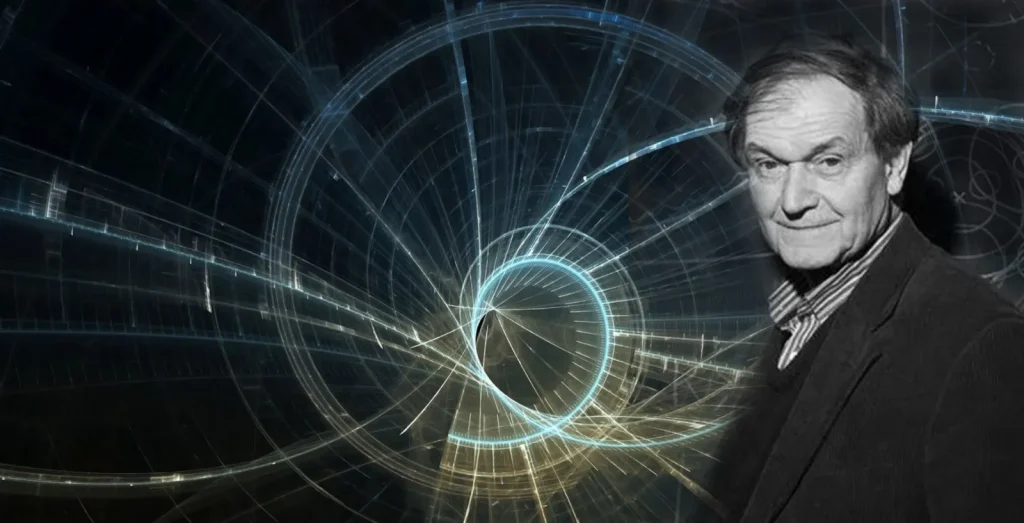
The comparison with Heraclitus can serve as a philosophical reflection on the transformation of the world. It provides no evidence that the ancient philosopher formulated this particular model. Even attributing a periodic destruction and rebirth of the entire world to Heraclitus himself remains a matter of interpretation.[3]
A Journey Through Thought
According to a later story recorded by Diogenes Laertius, Socrates, after reading the work of Heraclitus, remarked that a Delian diver was needed to reach its depths. Whatever its historical accuracy, the story aptly conveys the demands of his language.[2]
Heraclitus continues to invite such a dive. A journey through thought in which change, measure, and the relationship between opposites acquire depth once again.
Let us hold on to this image, then: a world in transformation, and a human being trying, amid its changes, to hear Logos.
Sources
- Heraclitus, fragments B2, B12, B30, B51, B53, B84a, B89, B94 (Diels–Kranz numbering).
- Diogenes Laertius, Lives of the Eminent Philosophers, 9.1–6 and 2.22. Later biographical testimony.
- Daniel W. Graham, “Heraclitus,” Stanford Encyclopedia of Philosophy (revised 2023), especially §§1, 3.1 and 4.
- Krzysztof A. Meissner and Roger Penrose, The Physics of Conformal Cyclic Cosmology (2025), arXiv:2503.24263.
Related Reading
Pythagoras and the Music of the Spheres