If we could hear the movement of the planets, what would we hear?
An endless symphony? A sequence of notes repeating for billions of years? Or perhaps nothing at all?
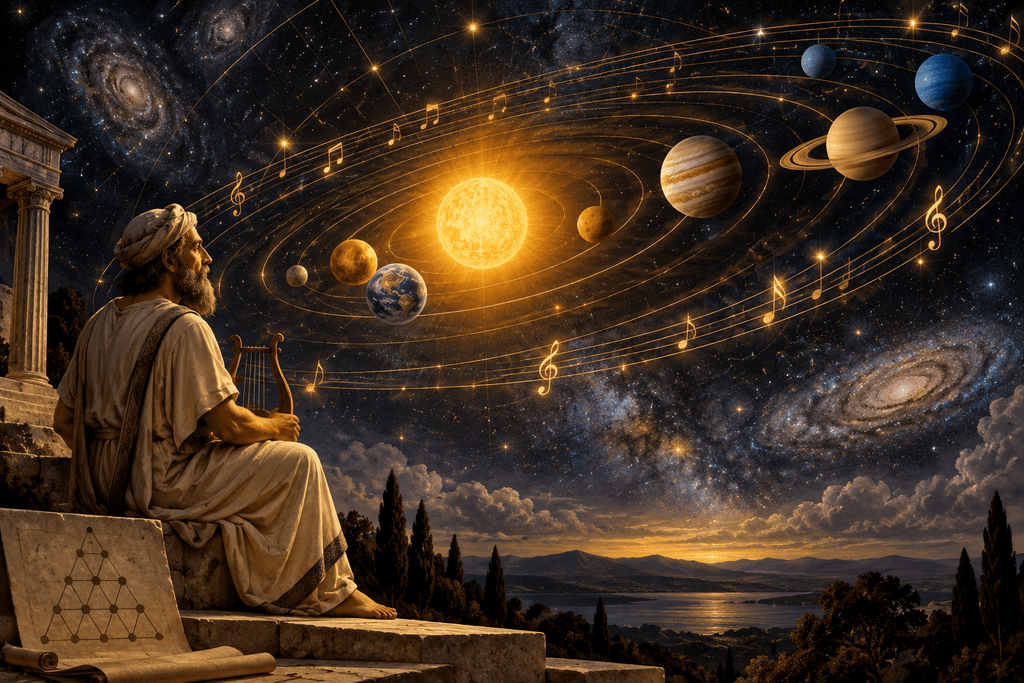
The Music of the Spheres is one of the most fascinating ideas in ancient philosophy. It became associated with Pythagoras and the Pythagorean tradition, which sought mathematical relationships not only in music but also in the structure of the world.
According to this idea, the movements of celestial bodies express a harmonious order, analogous to the relationships we recognise in musical intervals.
This music was not necessarily a sound that could be recorded or heard. In different versions of the tradition, it could be understood as a real but imperceptible sound, a mathematical relationship, or a philosophical image of cosmic order.
And here a question arises that reaches beyond music: can harmony be a property of reality itself, or is it a way in which human beings interpret reality?
Pythagoras and the Search for Harmony
In the Pythagorean tradition, numbers and proportions occupy a central place in understanding nature.
The observation that certain musical intervals correspond to simple numerical ratios was particularly important in ancient musical theory.
An octave, for example, corresponds to a frequency ratio of 2:1, a perfect fifth to 3:2, and a perfect fourth to 4:3.
These relationships offer a remarkable example: something we experience through our senses, such as musical harmony, can be described with mathematical precision.
From this connection emerged a daring philosophical extension. If music is governed by numerical relationships, might similar relationships also organise the movements of celestial bodies?
The ancient conception of the cosmos as a harmoniously ordered whole became connected with this search.
We must, however, remain cautious. We have no surviving writings by Pythagoras himself. Many details concerning the Music of the Spheres come from later authors and cannot be attributed with certainty to the historical philosopher.
A Music We Cannot Hear
In some ancient accounts, the movement of celestial bodies was believed to produce sounds. Our inability to hear them was explained, among other things, by the suggestion that we had heard them continuously since birth and therefore could no longer distinguish them.
Aristotle examines and criticises such a Pythagorean conception in his work On the Heavens.
Modern physics does not support the idea that planets produce a continuous, audible music as they travel through space.
Sound, in its usual physical sense, is a mechanical wave and requires a material medium through which to propagate. In the near-vacuum of interplanetary space, it cannot travel as it does through air.
This does not mean that space is devoid of every kind of wave or oscillation. Astrophysics studies electromagnetic waves, plasma oscillations, and other physical processes, some of which can be converted into audible representations.
Such a sonification of data, however, does not confirm the ancient theory.
The significance of the Music of the Spheres lies elsewhere: in the attempt to understand the Universe as a whole whose parts are connected through relationships.
Plato and the Harmony of the World Soul
Pythagorean thought significantly influenced later philosophy, particularly Plato.
In the Timaeus, Plato presents a world organised according to mathematical relationships. The Demiurge constructs the soul of the world using specific numerical proportions.
Two sequences appear in the relevant passage:
1, 2, 4, 8
and
1, 3, 9, 27
The first arises through successive doublings, while the second arises through successive triplings.
Between these numbers, further proportions are introduced that relate to musical theory, including the ratios 3:2, 4:3, and 9:8.
This construction is not a modern astronomical description. It belongs to the philosophical cosmology of the Timaeus, where mathematical order is connected with the formation of the world soul.
Plato does not merely present a Universe that produces musical notes. He proposes a deeper relationship between mathematical proportion, movement, and organised reality.
In the Republic, within the Myth of Er, a different but related image appears: the celestial revolutions are associated with eight Sirens, each producing a single tone, together forming a harmony.
Here, the Music of the Spheres takes on a more explicitly poetic and mythological form.
The distinction between these two works matters. The Timaeus develops a mathematically organised cosmology, while the Myth of Er employs the image of celestial music within a broader philosophical narrative.
Kepler and the Harmony of the World
Many centuries later, Johannes Kepler returned to the idea of cosmic harmony.
In his work Harmonices Mundi (The Harmony of the World), published in 1619, he searched for mathematical relationships between planetary motions and musical intervals.
Kepler knew that planetary orbits were not perfect circles. He had already established that planets move along elliptical orbits, with the Sun at one focus.
In his musical interpretation, he paid particular attention to variations in the planets’ angular velocities as viewed from the Sun, seeking ratios that could be associated with musical intervals.
Thus, the ancient search for harmony encountered a new and mathematically more precise astronomy.
Remarkably, in the same work, Kepler formulated his third law of planetary motion:
T² ∝ a³
Where:
- T is a planet’s orbital period.
- a is the semi-major axis of its elliptical orbit.
In other words, for bodies orbiting the same central body, the square of the orbital period is proportional to the cube of the semi-major axis.
This is a genuine mathematical relationship in celestial mechanics, understood today through gravitational theory.
It does not confirm that planets produce musical notes. It does, however, demonstrate that the search for mathematical order in celestial motion could lead to scientific discoveries.
Perhaps this is one of the most interesting historical encounters between philosophy and science: an aesthetic and metaphysical conviction can inspire research without constituting scientific proof in itself.
The Music of the Spheres in Art
The idea of cosmic harmony was not confined to philosophy and astronomy.
It influenced musical thought, literature, and the visual arts, offering artists an image of the Universe as a composition.
In the Western medieval tradition, the concept of musica mundana, the music of the world, became particularly associated with Boethius, who distinguished cosmic music from human music and instrumental music.
In this broader sense, music was not limited to what we hear. It could signify the proportion and order believed to permeate nature.
In more recent times, the image of celestial harmony continued to inspire artistic creation.
Its power lies not in its literal accuracy but in its ability to transform an abstract idea, the order of the world, into an aesthetic experience.
The Connection with the Sacred Tetractys
The Sacred Tetractys is one of the most important symbols of the Pythagorean tradition.
The first four natural numbers form a triangle of ten points:
1 + 2 + 3 + 4 = 10
These same numbers allow the principal musical consonances to be expressed through simple ratios.
This connection helps explain why the Tetractys acquired such profound symbolic significance. It brought arithmetic, geometry, and music together in a single image.
At different stages of the Pythagorean tradition, the numbers 1, 2, 3, and 4 were also associated with concepts such as unity, distinction, synthesis, and completeness. These interpretations do not form a single, historically certain system that we can attribute to Pythagoras himself.
Their significance is primarily philosophical: they express an attempt to understand how multiplicity can be organised through relationships.
Pythagorean Musical Ratios
The simple numerical ratios associated with musical consonances can be presented as follows:
| Musical interval | Frequency ratio | String-length ratio* |
|---|---|---|
| Octave | 2:1 | 1:2 |
| Perfect fifth | 3:2 | 2:3 |
| Perfect fourth | 4:3 | 3:4 |
| Major whole tone | 9:8 | 8:9 |
String-length ratios are expressed as the length of the string producing the higher pitch relative to the length of the string producing the lower pitch, assuming all other physical parameters remain constant.
These ratios describe real acoustic relationships. They do not prove that the Universe functions as a musical instrument, but they demonstrate how mathematical structure can be connected with human experience.
And perhaps this is more interesting than the metaphor itself.
Music is not merely number. It is sound, time, perception, and emotion. Yet numerical relationships contribute to its structure.
A mathematical description, therefore, does not eliminate experience. It allows us to recognise part of its underlying organisation.
From Cosmic Harmony to Modern Physics
Modern science does not describe the Universe as a divine musical composition.
It does, however, describe many physical processes through mathematical relationships.
Planetary orbits, stellar oscillations, wave propagation, and interactions of matter are studied using different mathematical tools.
Asteroseismology, for example, investigates oscillations within stars, providing information about their internal structure.
These oscillations are not the Pythagorean Music of the Spheres. They are physical phenomena that can be observed and analysed scientifically.
The distinction is essential.
The ancient theory began with a philosophical conviction concerning the harmony of the world. Modern science seeks relationships that can be formulated precisely, tested, and, when necessary, revised.
Despite these methodological differences, a common question remains: how are individual phenomena connected within a reality that we can understand?
Harmony as Relationship
The Music of the Spheres invites us to think beyond the image of singing planets.
It invites us to ask what harmony actually is.
Is it similarity? Symmetry? Repetition? Or perhaps the possibility that different things can coexist within a relationship that acquires meaning?
In music, two different notes can form an interval. Neither note, on its own, contains the proportion between them.
The proportion exists in their relationship.
This does not mean that relationships have been demonstrated to be the sole foundation of physical reality. Such a proposition would be a philosophical hypothesis, not an established scientific conclusion.
It does, however, allow us to consider the possibility that the identity and structure of a system cannot be exhausted by describing its individual components.
From the Pythagoreans to Kepler, and from ancient musical theory to modern physics, the search for relationships remains one of the most important instruments of human knowledge.
Perhaps, then, the Music of the Spheres is not a melody waiting to be heard.
Perhaps it is a reminder that, even when the Universe remains silent, we continue to search for the relationships that make it intelligible.
Subscribe for more, and feel free to suggest your favourite subjects for future exploration!
Until then, let’s see what changes!
Change is the only Constant
Sources and Further Reading
- Aristotle, On the Heavens, Book II, Chapter 9, 290b12–291a28, on the Pythagorean theory of celestial harmony and its criticism.
- Plato, Timaeus, 35b–36b, on numerical proportions in the construction of the world soul.
- Plato, Republic, 617b, on the Sirens and celestial harmony in the Myth of Er.
- Johannes Kepler, Harmonices Mundi, 1619.
- Stanford Encyclopedia of Philosophy, Pythagoras, Carl A. Huffman: https://plato.stanford.edu/entries/pythagoras/
- Andrew Barker, Greek Musical Writings, Cambridge University Press.
- Walter Burkert, Lore and Science in Ancient Pythagoreanism, Harvard University Press, 1972.