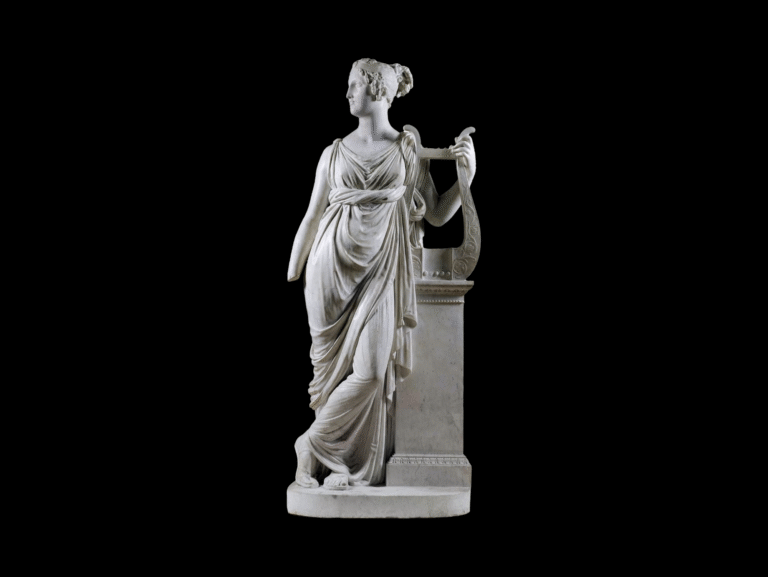
Today, let us begin our journey into ancient Greek philosophy with the remarkable Pythagoras, from the island of Samos.
Our cultural future ought to have its roots in the wisdom of the past, part of which remains accessible to us through the Pythagorean tradition. Pythagoras was extraordinarily influential throughout the centuries, and his intellectual legacy lives on to this day.
But how much do we really know about the man himself? And how much of what we attribute to him comes from those who continued, enriched, or even idealised his teachings?
Pythagoras: Between History and Tradition
Pythagoras was born on Samos around 570 BCE and died around 490 BCE, probably in Metapontum, in southern Italy. These dates are approximate, as the surviving sources do not allow us to reconstruct his life with precision.
He lived during an age of profound intellectual exploration, when significant religious and philosophical traditions were emerging in different parts of the world. His lifetime is often compared with that of the Buddha in India and figures of Chinese thought such as Laozi. However, the historicity and precise chronology of some of these figures remain debated, while the dating of Zoroaster is particularly uncertain.
According to later accounts, Pythagoras travelled to Egypt in pursuit of knowledge and spent time among the priests of Memphis, Heliopolis, and Diospolis. Some biographers claim that he remained there for twenty-two years, during which he was initiated into Egyptian religious traditions and sacred knowledge.
According to the same tradition, when Egypt was conquered by the Persians, Pythagoras was taken captive to Babylon. There, he is said to have encountered the knowledge of the region’s priests and sages before eventually returning to the Greek world.
These details are fascinating, but they do not constitute a verified biography. The most extensive accounts of his life were written many centuries after his death. It is possible that Pythagoras encountered Egyptian religious practices or Eastern traditions, but neither the duration of his travels nor the story of his captivity can be confirmed.
This does not diminish the value of these narratives. It does, however, allow us to distinguish the historical individual from the image of the sage created by tradition.
The Pythagorean Community and Its Way of Life
Around 530 BCE, Pythagoras settled in Croton, a Greek city in southern Italy, where he gathered students and followers. There, a community emerged that did not limit itself to theoretical teaching but embraced a distinctive way of life.
The Pythagorean community combined philosophical inquiry with religious practice, discipline, and ethical conduct. Self-restraint, care for the soul, and the relationship between the individual and the community occupied an important place within this tradition.
Later sources describe periods of silence, particular dietary rules, communal living, and different levels of participation in the teachings. We do not know, however, which of these practices originated with Pythagoras himself and which developed later.
His school was also associated with political influence in the cities of southern Italy. This influence appears to have provoked opposition and conflict.
As for his death, several different accounts survive. One later version claims that he took refuge in a temple of the Muses and died of starvation. Other traditions connect the end of his life with attacks against the Pythagoreans and the destruction of their community.
The relatively more reliable early evidence suggests that, following political conflict in Croton, Pythagoras sought refuge in Metapontum, where he died.
His story, then, is not merely the story of a philosopher. It is also the story of a community that attempted to turn its philosophical convictions into everyday practice.
The Soul, Reincarnation, and the Search for Perfection
One of the most significant teachings associated with Pythagoras concerns the immortality and transmigration of the soul.
According to Pythagorean tradition, the soul does not cease to exist when the body dies. Instead, it may continue its journey through successive lives.
Later interpretations describe this journey as a process of purification and perfection, through which the soul seeks liberation from the cycle of rebirth. The idea of ultimate union with the divine also appears in later philosophical readings, although we cannot confidently regard it as an authentic, established teaching of the historical Pythagoras.
Belief in the transmigration of souls was not exclusively Pythagorean, nor can we claim that Pythagoras was the first to teach humility, respect, or purification in ancient Greece. These ideas have complex histories and appear in different religious and philosophical traditions.
What is particularly important is that, in Pythagorean thought, the way we live is connected to the destiny of the soul.
Knowledge is not simply the accumulation of information. It acquires an ethical dimension. Human beings are called upon to work on themselves, cultivate self-discipline, and seek a deeper harmony between their actions and their beliefs.
This understanding leads us to a question that remains relevant today: can knowledge truly be called knowledge if it has no influence whatsoever on the way we live?
Mathematics as a Path to Knowledge
For the later Pythagorean philosophical tradition, mathematics was a method through which the mind could approach the study of stable and unchanging relationships.
A bridge and a means of communication between the visible and invisible worlds, rather than merely a tool for understanding and manipulating Nature.
In later interpretations of Pythagoreanism, particularly those influenced by Platonism and Neoplatonism, mathematical thought was presented as a path through which the mind could turn away from the changing world of the senses towards a deeper, intelligible order.
We must, however, distinguish these later interpretations from what can confidently be attributed to Pythagoras himself.
Pythagoras left no known authentic written works. Consequently, the image of him as a mathematician who had already developed a complete philosophical system is not confirmed by the earliest sources.
His significance, nevertheless, remains immense. The community and tradition associated with his name contributed to the development of a way of thinking in which numerical relationships, order, and proportion became central to understanding the world.
Numbers and the Structure of Reality
Within the Pythagorean tradition, numbers were not regarded merely as symbols of quantitative relationships.
They acquired a deeper philosophical significance, as principles through which the structure and order of things might be understood.
Aristotle reports that the Pythagoreans regarded the principles of numbers as the principles of existing things. His testimony is extremely important, but it concerns the Pythagorean tradition and does not prove that every related theory was formulated by Pythagoras himself.
On the one hand, numbers express abstract relationships. On the other, these relationships can be recognised in the natural world.
Proportion, symmetry, and repetition are not merely mathematical concepts. They are characteristics we encounter in natural phenomena, in music, and in many forms of organisation within matter.
This does not mean that modern science confirms the metaphysical claim that numbers are literally the essence of all things. It does mean, however, that the mathematical description of Nature has proved extraordinarily fruitful.
And here lies one of the most interesting bridges between ancient philosophy and modern scientific thought: why does the world exhibit relationships and regularities that can be described mathematically?
The answer is far from obvious. Yet the question itself deserves to remain open.
From Arithmetic to Cosmic Harmony
Arithmetic, geometry, music, and astronomy became closely associated with the Pythagorean tradition and eventually occupied a central place in later philosophical education.
Their study encouraged the search for relationships between seemingly different phenomena: numerical sequences, geometric forms, musical intervals, and celestial movements.
The systematic organisation of these four disciplines took shape in later periods. Nevertheless, the connection between mathematical order, music, and cosmology remains one of the most distinctive legacies of Pythagoreanism.
We will explore these ideas further in the other two articles of our Pythagorean series.
In The Sacred Tetractys, we will examine the numerical symbol associated with order, harmony, and the Pythagorean oath.
In The Music of the Spheres, we will explore the relationship between musical proportions, ancient cosmology, and the modern scientific understanding of the Universe.
Perhaps the most important legacy of Pythagoras is not a definitive answer about the nature of reality, but the persistence of the search for order and meaning behind what we observe.
And that is a journey that has not yet come to an end.
Until then, let’s see what changes!
Change is the only Constant
Sources and Further Reading
- Stanford Encyclopedia of Philosophy, Pythagoras, Carl A. Huffman. Historical evidence, ancient testimonies, the Pythagorean community, and the difficulties of attributing teachings to the historical Pythagoras.
- Stanford Encyclopedia of Philosophy, Pythagoreanism. The development of Pythagorean philosophy and the distinction between early traditions and later interpretations.
- Diogenes Laertius, Lives of the Eminent Philosophers, Book VIII. An ancient biographical source that must be read critically because of its historical distance from the events described.
- Porphyry, Life of Pythagoras. A later account of Pythagoras’ life and teachings.
- Iamblichus, On the Pythagorean Life. An important source for Pythagorean tradition, strongly influenced by philosophical and religious interpretations.
- Aristotle, Metaphysics, Book I, 5, 985b–986a. His account of the Pythagoreans and the significance of numbers in their understanding of reality.
- Walter Burkert, Lore and Science in Ancient Pythagoreanism, Harvard University Press, 1972. A foundational modern historical study.