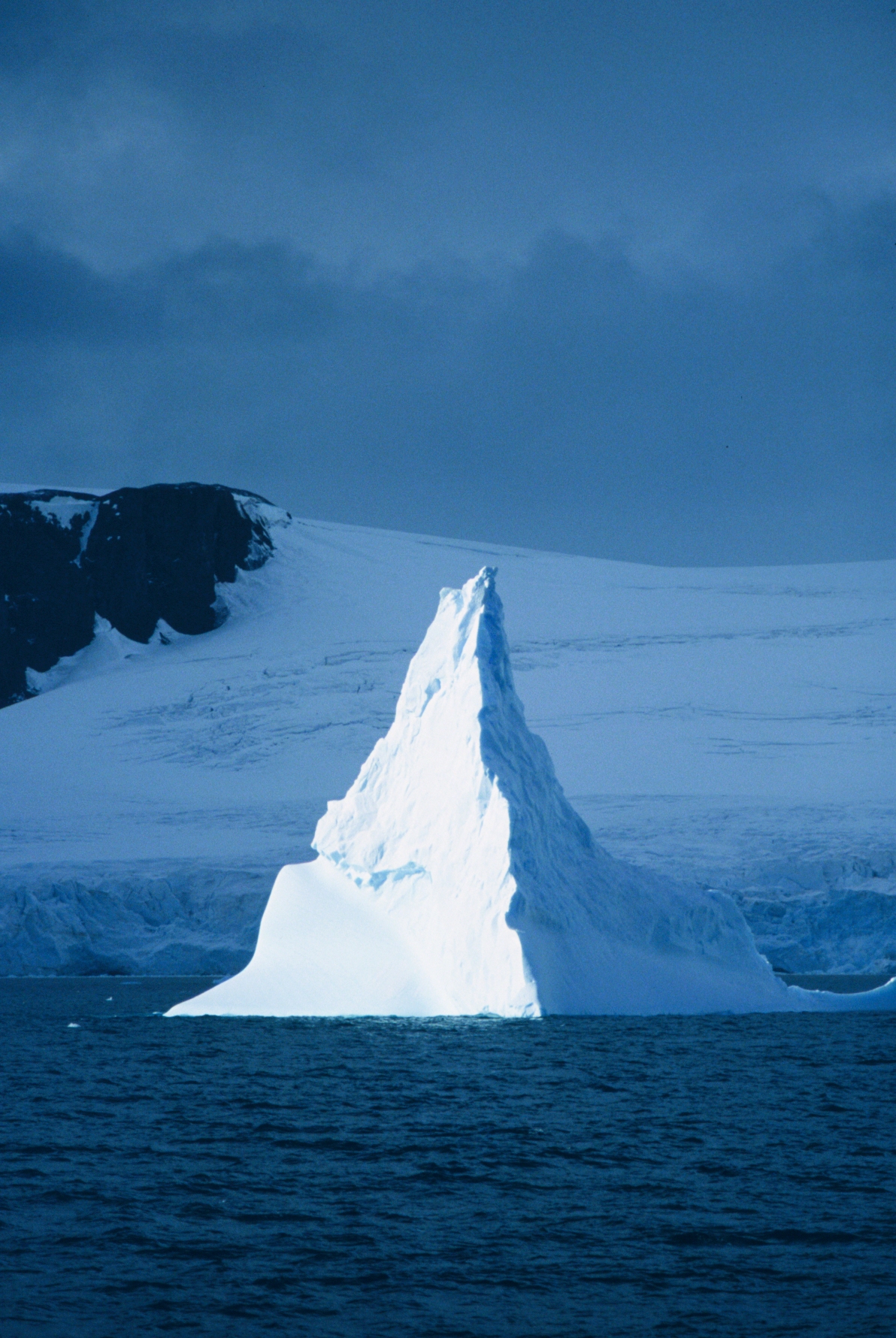

The strange physics of water reveals itself in something as ordinary as an ice cube floating in a glass. Yet most materials behave differently. When a liquid solidifies, its particles usually arrange themselves more compactly, making the solid denser than the liquid. That is why a piece of solid metal sinks in the same metal when it is molten. Water, by contrast, expands when it freezes, and ordinary ice floats.
This exception is more than a small trick of nature. It explains why most of an iceberg lies below the surface, why pipes can burst in winter, why lakes freeze from the top down, and why life can survive beneath a frozen crust. Behind all this lies the geometry of one of the simplest molecules: H₂O.
The first answer: density and buoyancy
Density tells us how much mass is contained in a given volume:
ρ = m / V
Here, ρ is density, m is mass, and V is volume. If two objects have the same mass, the one that occupies more space has a lower density.
Ice floats because it is less dense than liquid water. Near 0 °C, ordinary ice has a density of approximately 917 kilograms per cubic metre, while pure liquid water is close to 1,000 kilograms per cubic metre. On freezing, the same number of molecules occupies about 9% more space. [1, 3]
Archimedes’ principle completes the picture. An object immersed in a fluid experiences an upward force equal to the weight of the fluid it displaces. At equilibrium, an iceberg sinks far enough for the weight of the displaced water to equal its own weight. For a simple cube of pure ice in fresh water, the submerged fraction is approximately:
Submerged fraction ≈ ρice / ρwater ≈ 0.917
So about 92% of its volume lies below the surface, with only 8% above it. At sea, the exact proportion changes because salt water is denser, and natural ice contains bubbles, cracks, or salts. The familiar phrase “the tip of the iceberg” is therefore almost literal physics. [2]
A small molecule with an uneven distribution of charge
A water molecule consists of one oxygen atom and two hydrogen atoms. It is not straight. It has a bent shape, with an angle of approximately 104.5°. Oxygen attracts the shared electrons more strongly than hydrogen does. As a result, the oxygen side acquires a small partial negative charge, while the hydrogen sides acquire small partial positive charges.
Water is therefore a polar molecule. The slightly positive hydrogen of one molecule is attracted to the slightly negative oxygen of a neighbouring molecule. This intermolecular attraction is called a hydrogen bond. It is much weaker than the covalent bond holding the atoms together within a single molecule, but when billions of molecules interact at once, the collective effect is powerful. [3]
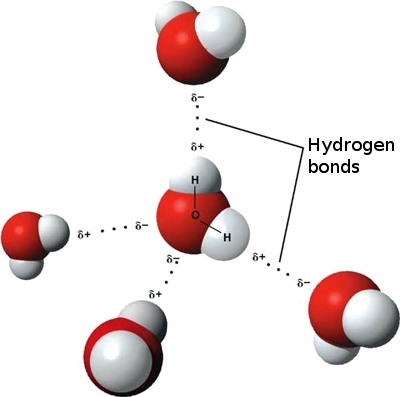
These bonds explain many of water’s properties: its relatively high boiling point for such a small molecule, its high heat capacity, its surface tension and, in the solid phase, the open crystal structure that allows ice to float.
What changes when water freezes
In liquid water, molecules move, rotate, and constantly change neighbours. Hydrogen bonds form and break over very short timescales. The network has local organisation, but remains flexible: some molecules can move close together and fill gaps.
As the temperature falls and ordinary ice Ih forms, each molecule tends to bond with four neighbours in an approximately tetrahedral arrangement. The network acquires hexagonal symmetry. This ordered arrangement is not the most compact possible packing. It creates empty space within the lattice, like a three-dimensional structure with open passageways.
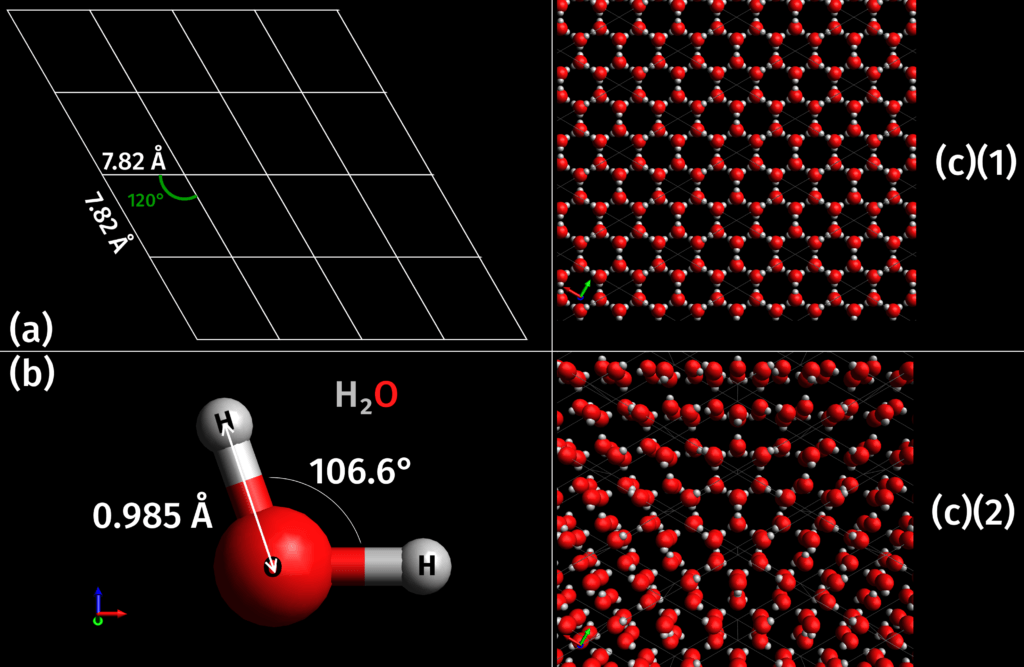
The crucial point is that order does not always mean greater density. In ice, hydrogen bonds hold the molecules at distances that form a relatively open lattice. In the liquid, the network’s constant rearrangement allows a more compact average arrangement. That is why water increases in volume when it freezes. [3]
Water is not the only material whose solid phase is less dense than its liquid phase. Bismuth and silicon, for example, show similar behaviour. But it is a rare and exceptionally important case on the scale of everyday life.
Water is densest near 4 °C, not at 0 °C
This unusual behaviour begins before freezing. Most liquids contract as they cool because thermal motion decreases and the molecules move closer together. Water follows this trend as it cools from higher temperatures to about 4 °C, where it reaches its maximum density at ordinary atmospheric pressure.
Below 4 °C, the opposite happens: further cooling increasingly favours the open, tetrahedral organisation of hydrogen bonds. The structure begins to “open up”, and density decreases. Once the crystal forms, the decrease becomes more pronounced.
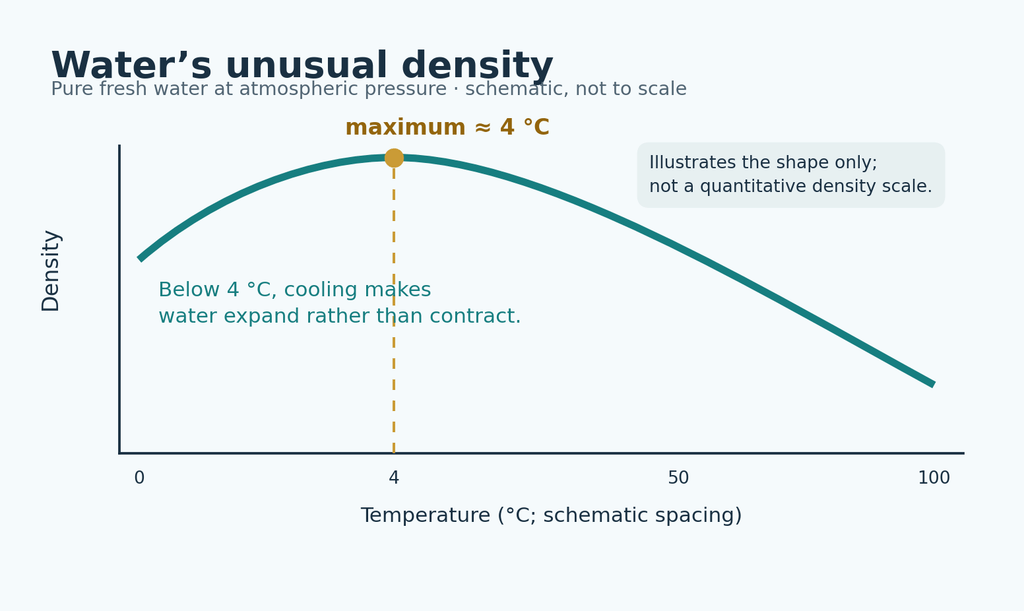
This competition between thermal motion, which makes the liquid less dense at higher temperatures, and the hydrogen-bond network, which opens it up at very low temperatures, produces the characteristic density peak. The exact value depends on pressure and dissolved substances. Seawater, for example, does not behave in exactly the same way as pure fresh water. [3]
Why a lake freezes from the top
Let us follow a deep lake as winter approaches. The surface water cools as it loses heat to the air. As its temperature falls towards 4 °C, it becomes denser and sinks, while warmer water rises. This circulation mixes the lake.
But once the surface water becomes colder than about 4 °C, further cooling no longer makes it denser. It becomes less dense and stays on top. The surface can reach 0 °C and freeze, while liquid water near 4 °C remains below. [4]
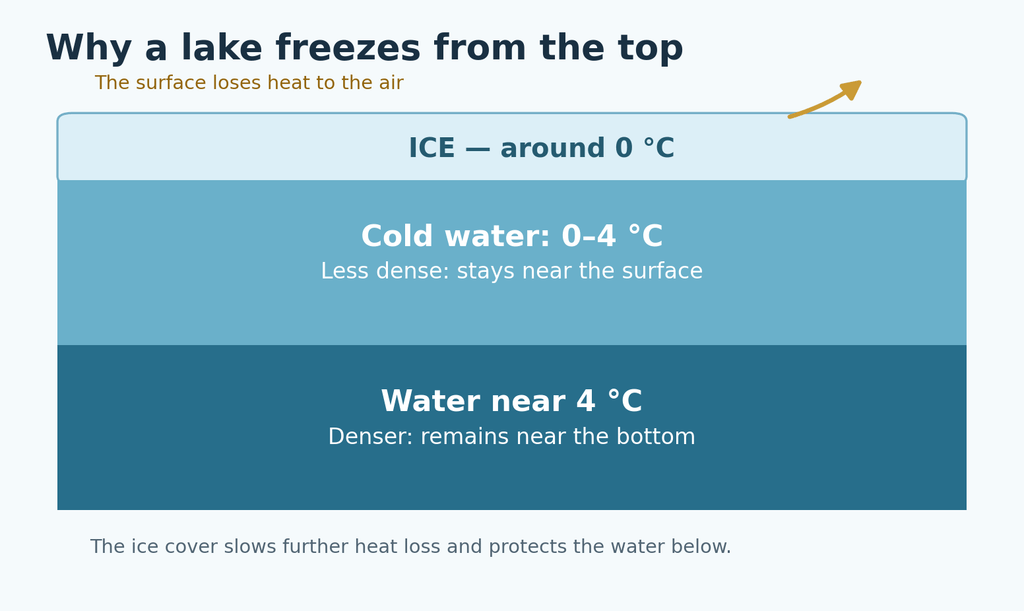
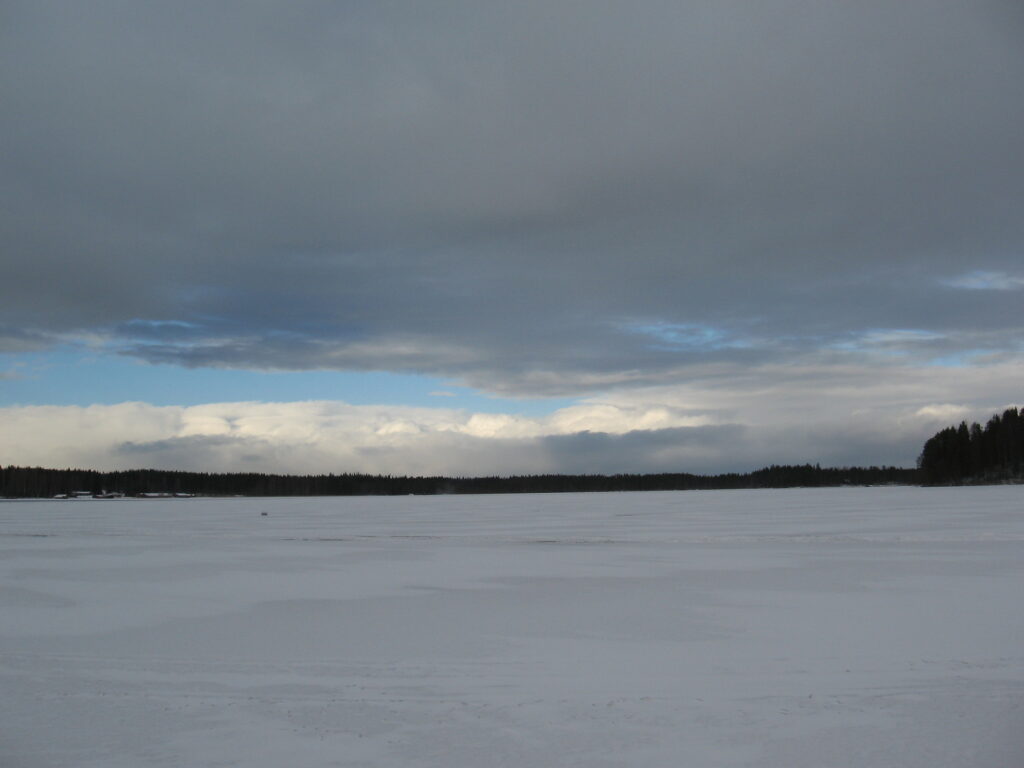
The ice that forms floats, creating a protective cover. It is not a perfect insulator, but it limits contact between the water and the cold air and slows heat loss. Light levels fall, and the supply of dissolved oxygen can become a problem in some lakes, but the whole body of water does not readily turn solid. Fish, microorganisms, and plants can survive in the liquid layer.
If ice were denser than water, each new layer would sink. The surface would be exposed to the cold air again, allowing freezing to progress downwards in successive stages. This does not mean that every lake would always freeze all the way to the bottom: depth, climate, and water flow would still matter. But today’s protective layering would be absent.
Pressure, salt, and the different forms of ice
The familiar picture concerns ice Ih at low pressures. At very high pressures, water forms other crystalline phases with different arrangements and, often, higher densities. The physics of water includes many forms of ice, not just one. [5]
Pressure also affects the melting point. Because ordinary ice occupies more volume than liquid water, increasing the pressure slightly favours the denser liquid phase and lowers the melting point. This effect is real, but it is not enough on its own to explain every instance of slipperiness on ice. Friction and the extremely thin, more mobile surface layer also play important roles. [5, 6]
At sea, salts lower the freezing temperature. As sea ice forms, much of the salt is expelled into the water below. The water becomes saltier and denser, sinks, and contributes to large-scale ocean circulation. In this way, the microscopic structure of hydrogen bonds ultimately connects with processes on a planetary scale. [4, 7]
An exception that became a condition for life
An ice cube floats because buoyancy balances its weight. Its lower density, however, has much deeper origins: the polar shape of the water molecule, hydrogen bonds, and the open geometry of the crystal. From this geometry come icebergs, frozen lakes, winter layering, and a refuge for life beneath the ice.
The story reminds us that what is “normal” is not always what matters most. Sometimes the history of a planet depends on a departure from the usual pattern: on a liquid that, instead of continuing to contract, begins to expand shortly before it freezes. Life on Earth does not simply inhabit water. It also inhabits its peculiarities.
Sources and further reading
- U.S. Geological Survey. Water Density. Water Science School.
- OpenStax. Archimedes’ Principle and Buoyancy. University Physics, Volume 1, Section 14.4.
- International Association for the Properties of Water and Steam (IAPWS). FAQs About Water and Steam. Sections on molecular structure, the density maximum, and expansion on freezing.
- Wadhams, P. How does Arctic sea ice form and decay? NOAA Arctic Zone.
- IAPWS (2011). Revised Release on the Pressure along the Melting and Sublimation Curves of Ordinary Water Substance. R14-08(2011).
- Baran, Ł., Llombart, P., Rżysko, W. & MacDowell, L. G. (2022). Ice friction at the nanoscale. Proceedings of the National Academy of Sciences, 119(49), e2209545119.
- NOAA. Thermohaline Circulation. National Ocean Service Education.
Change is the only Constant