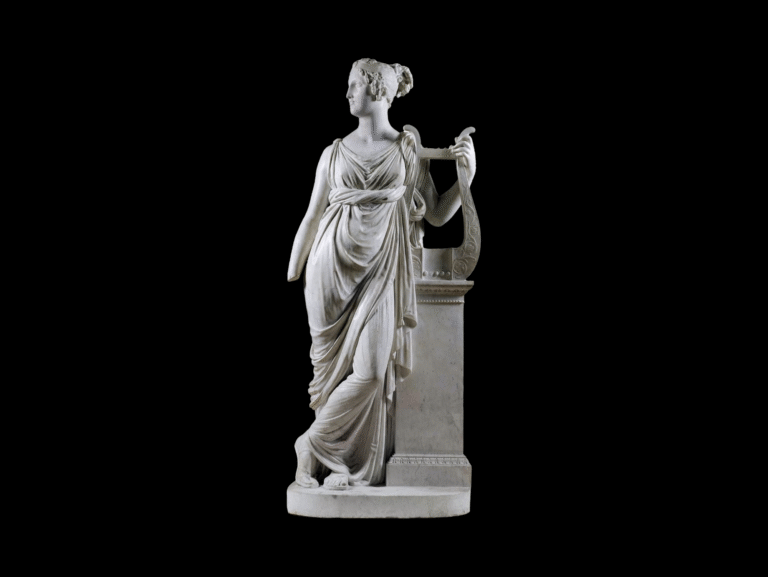
Long before Saturn revealed its magnificent rings to humanity through telescopes, it already held a special place in the human imagination. In the night sky, it was one of the few celestial bodies that could be observed moving among the fixed stars. In the world of mythology, however, its name became associated with power, the succession of generations, and the memory of a lost age of prosperity.
In Greek mythology, Cronus was one of the Titans, the son of Uranus and Gaia. According to Hesiod’s Theogony, Gaia, distressed by Uranus’s treatment of their children, sought their help. Cronus was the one who responded, overthrowing his father and seizing power. This act marked the beginning of a new era in the history of the gods, but it also established a cycle of fear and succession: Cronus himself would eventually face a threat from his own children.
Fearing the prophecy that one of his descendants would overthrow him, Cronus swallowed the children he had with Rhea. She eventually managed to save Zeus by giving Cronus a stone wrapped in swaddling clothes. When Zeus grew up, he brought about his father’s overthrow and the triumph of the Olympian gods.
Yet Cronus was not remembered in mythology solely as the dark figure of a father who feared his own children. His name also became associated with one of antiquity’s most fascinating ideas: the Golden Age.
The Golden Age of Cronus
In Hesiod’s Works and Days, the first generation of mortal humans lived during the time when Cronus ruled in heaven. This was the Golden Race, a humanity unfamiliar with the harsh labor, illness, and suffering of later life. People lived without fear of old age and died peacefully, as though overcome by sleep. The earth offered its fruits abundantly, without demanding exhausting cultivation, and life unfolded in prosperity.
The Golden Age is not a historical description of an actual past. It is a mythological image through which the ancients reflected on the human condition. Abundance, freedom from exhausting labor, and peaceful coexistence are contrasted with the difficulties of the present. The narrative thus raises a question that remains relevant: is human history necessarily a path of progress, or can it also involve the loss of an original harmony?
In Hesiod’s account, the history of humanity does not follow a simple linear progression. The Golden Race is succeeded by the Silver Race, the Bronze Race, the Race of Heroes, and finally the Iron Race, to which the poet assigns his own age. Across these generations, justice, violence, labor, and humanity’s relationship with the divine undergo transformations. The presence of the Race of Heroes complicates the idea of uninterrupted decline, leaving room for a more nuanced understanding of human history.
Later, in Roman tradition, Cronus was identified with Saturnus, a deity associated with agriculture and abundance. The Saturnalia, the great festival held in his honor, included feasting, the exchange of gifts, and temporary reversals of certain social conventions. Within the celebration, the memory of an age in which people imagined life as less constrained by inequality and everyday demands survived symbolically.
It is worth distinguishing the mythological Cronus from Chronos, the personification of time. Although these figures became associated and merged in later philosophical and allegorical interpretations, they were not originally identical. Cronus is the Titan of divine genealogy, while Chronos represents a distinct personification of time in other traditions. Their later association enriched the symbolism of Cronus with concepts such as decay, duration, and the inevitable succession of generations.
From Myth to Observation
The Cronus of mythology symbolizes, in different ways, the transfer of power, the loss of harmony, and humanity’s attempt to give meaning to change. Saturn in astronomy, by contrast, is not a symbol but a physical object: a giant planet of the Solar System, with an atmosphere, moons, a magnetic field, and a remarkable ring system.
Between these two images lies a substantial part of the history of human knowledge. The same bright planet that inspired mythological narratives later became an object of systematic observation, mathematical description, and space exploration.
Science does not need to invalidate mythology in order to advance. We need only distinguish between the different ways in which human beings approach the world: sometimes seeking meaning through narratives, and sometimes seeking explanations through observations and evidence.
Humanity’s attempt to understand the order of the heavens was not limited to mythology. In ancient philosophy, the motion of celestial bodies became associated with mathematical proportions and the idea of cosmic harmony, as we explore in our article on the Music of the Spheres.
Let us now discover Saturn as revealed by astronomy.
The Planet Saturn

Saturn, together with Jupiter, Uranus, and Neptune, belongs to the outer planets of our Solar System, also commonly referred to as the giant planets. It is the sixth planet from the Sun and lies at an average distance of 9.5 AU (149,597,871 km per AU). Its mass is 5.6846 × 10²⁶ kg, making it approximately 95 times more massive than Earth. This makes Saturn the second-largest planet in the Solar System after Jupiter.
The rings surrounding Saturn constitute its most distinctive feature and, together with its moons, form a complex, interconnected system of objects whose structures, dynamics, and evolution are closely related. The orbits of the inner natural satellites lie within or between the outer rings, while new satellites continue to be discovered embedded within their structures. Because of the difficulty of distinguishing large ring particles from small moons, determining the exact number of Saturn’s moons may not always be possible.

Exploration and Space Missions

The first spacecraft to visit Saturn, the American Pioneer 11, was one of two spacecraft launched in the early 1970s toward Jupiter. Although redirecting the spacecraft was not part of its original objective, mission controllers took advantage of its close encounter with Jupiter’s gravitational field to alter its trajectory and place it on a new course toward Saturn. In 1979, Pioneer 11 crossed the plane of Saturn’s rings at a distance of just 38,000 km from the A ring and passed within 21,000 km of its atmosphere.
The twin spacecraft that followed, the American Voyagers 1 and 2, were initially launched toward Jupiter in 1977. They carried considerably more sophisticated imaging equipment and were specifically designed for multiple planetary flybys, as well as to achieve particular scientific objectives at each destination. As with Pioneer 11, Jupiter’s gravitational field was used to perform the necessary maneuvers and redirect the spacecraft toward Saturn, which they encountered in 1980 and 1981, respectively. Together, the two spacecraft provided thousands of images of Saturn, its rings, and its moons.
The Cassini–Huygens spacecraft was launched in 1997 as a joint project of the space agencies of the United States (NASA), Europe (ESA), and Italy (ASI).
It followed a complex trajectory based on gravitational-assist maneuvers during flybys of Venus (twice), Earth, and Jupiter, which brought it to the Saturnian system in mid-2004. Weighing almost six metric tons when fully loaded with propellant, it was one of the largest, most expensive, and most complex spacecraft of its time.
It was designed to study the planet, its rings, and its moons over several years. It also carried the Huygens probe, which descended by parachute through Titan’s atmosphere and landed on the moon’s solid surface in early 2005. For approximately three hours during its descent and from the surface, Huygens transmitted measurements and images to Cassini, which relayed them to scientific centers on Earth.
The Cassini mission was planned to continue, provided the spacecraft remained operational, until 2017. As its fuel supply approached depletion, the spacecraft made a series of very close passes by the planet, measuring its magnetic and gravitational fields, before finally entering a trajectory that took it into Saturn’s atmosphere.
Magnetosphere


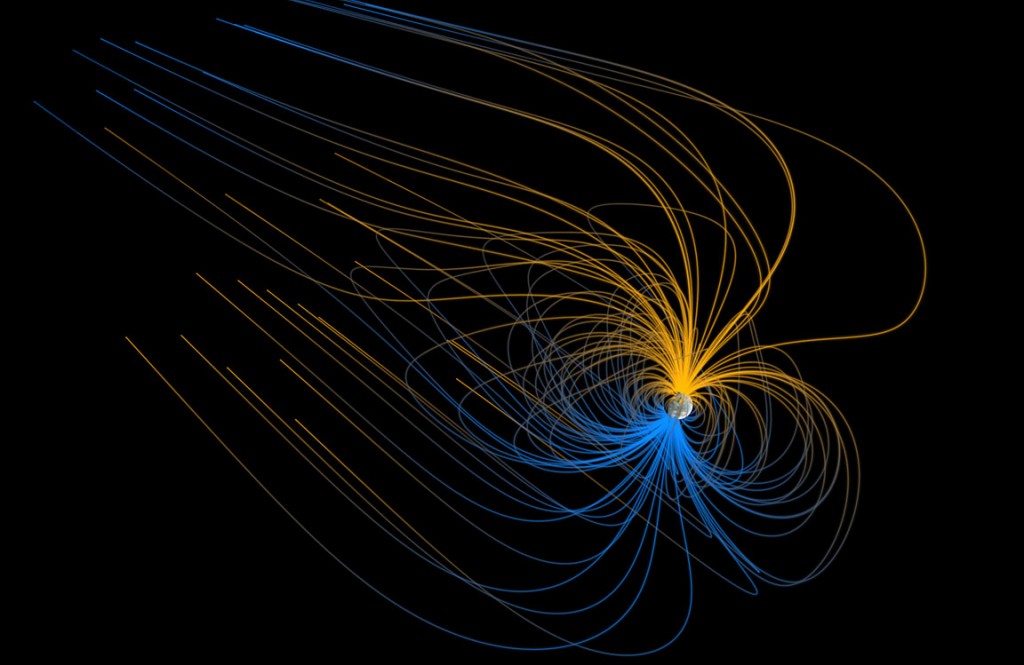
As its name suggests, a planet’s magnetosphere is the region of space influenced by its magnetic field. The Voyager missions to the distant regions of the Solar System confirmed that, like Earth, all four giant planets possess extensive magnetospheres due to their strong magnetic fields, which are generated through convection within electrically conductive regions of their interiors.
Saturn’s magnetic field is strongly bipolar, with quadrupolar, octupolar, and higher-order components also present.
Saturn is a fascinating planet, as well as a formidable mythological figure, and it will always stimulate our imagination and curiosity.
Scientific content reference: Ioanna Theofilakou, undergraduate thesis, “The Βipolar Character of Saturn’s Magnetic Field.”
Sources for the Mythological Introduction
- Hesiod, Works and Days, lines 109–139: the Golden Race and the reign of Cronus. Perseus Digital Library
- Hesiod, Theogony, lines 453–491: Cronus, Rhea, and the birth of Zeus. Fordham Ancient History Sourcebook
- Hesiod, Works and Days, lines 140–173: the succession of human generations. Perseus Digital Library
Change is the only Constant