
The divine order behind the Universe
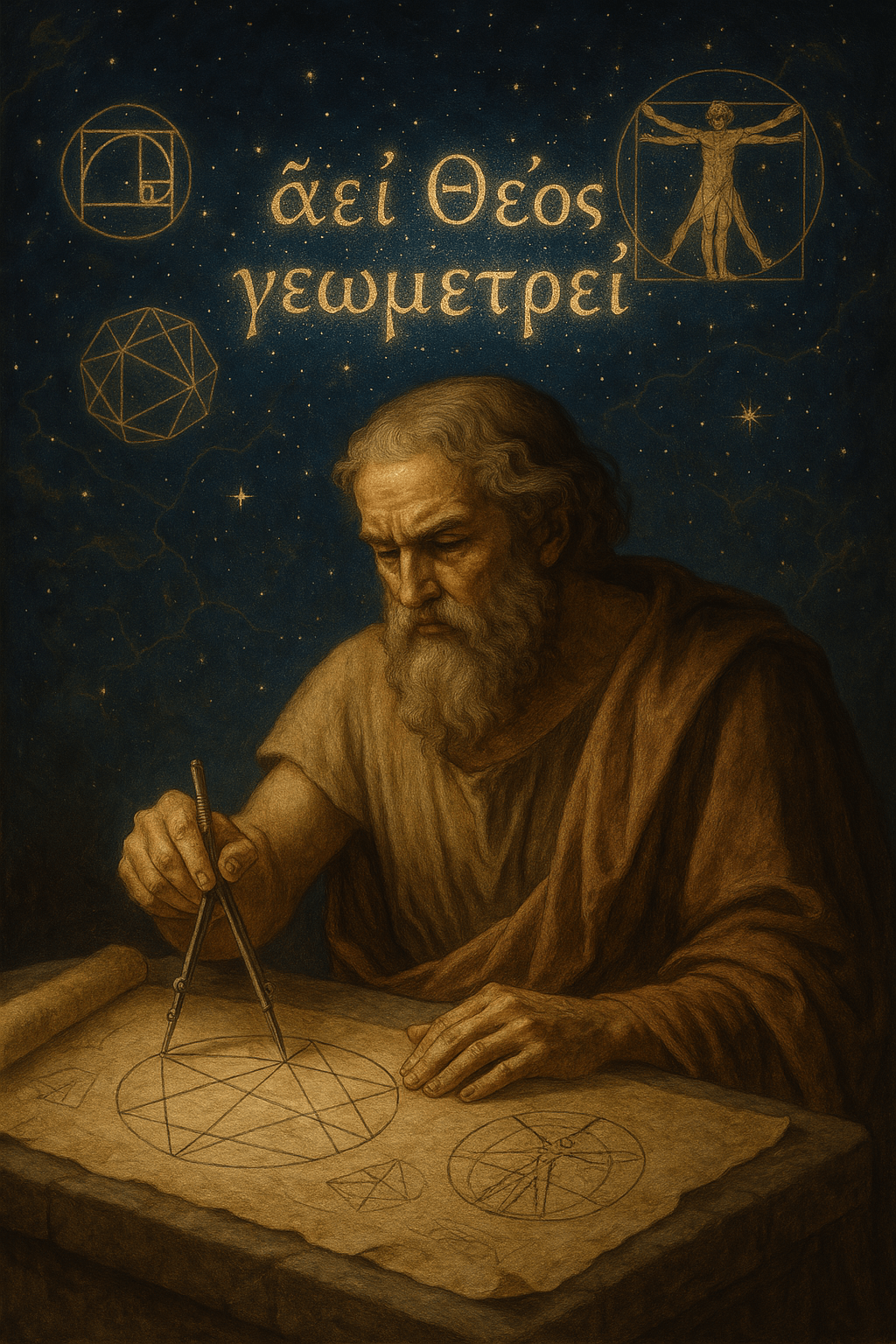
In ancient Greek philosophy and science, there is a saying that captures with profound simplicity the belief that the Universe is not a chaotic whole, but a perfectly structured system based on harmony, proportion, and mathematical logic: “ἀεὶ Θεὸς γεωμετρεῖ” — God always geometrizes.
The phrase is attributed to Plato, or at least to the Platonic school of thought, and contains within it an entire worldview. God, the Creator, or the Divine Mind, does not create the world randomly. He “designs” it, just as a geometer draws circles, triangles, and spirals with absolute precision. The Universe itself, therefore, is a divine work of geometric art.
Geometry, the Language of Creation
From the symmetry of flowers and the helix of DNA to the structure of galaxies and the orbits of planets, nature “speaks” geometrically. The ancient Greeks understood this well, not as scientists in the modern sense, but as philosophers who perceived the beauty and wisdom of the world through mathematical order.
Pythagoras believed that “everything is number.” Plato, at the entrance to his Academy, was said to have inscribed: “Μηδεὶς ἀγεωμέτρητος εἰσίτω” — “Let no one ignorant of geometry enter.” The world of the Ideal, the perfect world of Forms, was for him filled with shapes and harmonies shaped by the mind of God.
God as Mathematician
In medieval and Renaissance thought, this phrase experienced a revival. Artists and scientists such as Leonardo da Vinci and Johannes Kepler were inspired by it to study the proportions of the human body, music, and planetary motion. Newton himself, a believer in the divine order of the Universe, regarded the laws of nature as the “writing of God.”
Even today, physicists and mathematicians are fascinated by the fact that the most fundamental laws of our world can be expressed through simple, elegant equations. Nature seems to “understand” mathematics. Or rather, mathematics may be the very “software” of creation.

Modern Perspective: Chaos or Order?
Some may say that the world is chaotic and unpredictable. Yet even within chaos, science discovers structures, such as fractals and patterns in chaos theory. It seems as though the Universe plays a game between freedom and structure, randomness and order.
If indeed “God geometrizes,” perhaps this means that behind every instability lies a deeper design. Perhaps we ourselves, as part of the Universe, “carry” this geometric balance within us, in our thoughts, in the music we create, and in the art we love.
A World with Meaning
The saying “ἀεὶ Θεὸς γεωμετρεῖ” is not merely a philosophical statement. It is a reminder that the Universe is not random. It is a poem written in shapes. A symphony played on mathematical strings. And perhaps, if we can learn to “listen” to its geometry, we may also come to understand something deeper about ourselves.
Subscribe for more!
Change is the only Constant